

Posts
2712Following
117Followers
680I try to be very careful about CWing things. sometimes I make mistakes but I want to make my posts as safe to read as possible
I sometimes post NSFW/kinky/lewd things behind CWs. this should go without saying but if you're a minor please do not interact with anything lewd/NSFW that I post
I have very limited energy and am very shy so it might take me a long time to reply to messages sometimes, or I might not be able to reply at all. this is kind of an "output only" account for the most part, but I'm hopeful that I can change that over time
I sometimes use curly braces to {clearly show where a grammatical phrase begins and ends}, like that. you can think of them like parenthesis in code or math, except they operate on grammar instead
 repeated

Nat
nat@kind.social
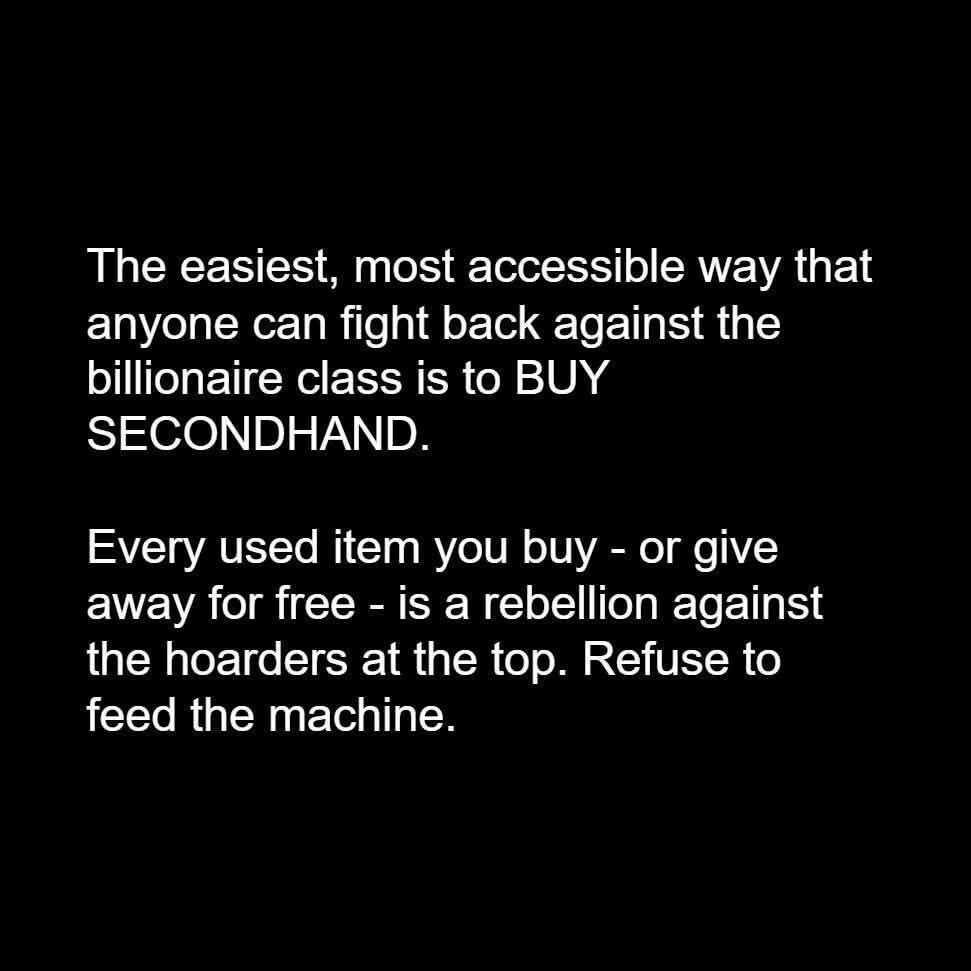
✨ Buy Nothing groups
✨ Clothing banks
✨ Thrift stores (look for their sale days)
✨ Facebook marketplace (set max price to 0 or a few bucks)
✨ Clothing swaps
✨ Yard sales / Estate sales
✨ Ask your community for what you need
You do NOT need to buy new clothes or holiday decor this week. You do NOT need to buy new, period!
What if you challenged yourself not to buy anything new for the rest of the year—and nothing at ALL during the national economic blackout from today thru December 2?
 1
2
1
2
 1
repeated
1
repeated


 repeated


 repeated

Zelda 🎀
TheZeldaZone@mastodon.socialAd:
If you're Black Friday shopping on Bezos Land * you can support your favorite princess (me) with this affiliate link, doesn't cost you any extra:
*I swear the deals are worse every year
0
2
1
 repeated

Eivind (like the Terrible) ✨
eivind@fribygda.noFour bendy buses managed to enter a roundabout at the exact same time from four different directions in Oslo yesterday afternoon and get properly stuck, each bus blocking the exit for the one behind it. #BigBusStuck
 8
15
2
8
15
2
kasdeya
kasdeya@rowan @eclairwolf I’m so glad you liked it so much! 💙 Bambara is amazing and so is this whole album
0
0
2
repeated

Mendie 


Mendie_Taoma@tech.lgbt
Talking to a co-worker about the ADHD tendency to keep too many photos on your phone.
Mendie: ... And then, I actually keep this photo in my phone, itself, so I don't know what that says about me.
 6
8
1
6
8
1
kasdeya
kasdeya@liese oohh I haven’t but that sounds great for me! I have been meaning to try F# at some point - I think you might’ve been the one who originally recommended it
although now that I look at it a little more, it looks intimidatingly similar to Haskell on the surface. it looks like it has much better documentation though omg - so that’s a huge plus that I really appreciate
I’ll definitely give this site a look when I get the chance, and thanks for mentioning it
1
0
1
repeated

 repeated

 repeated

Kit Bashir
Unixbigot@aus.socialI got nerdsniped by your shitpost into trying to write a Forth interpreter in RNA. It didn’t actually take that long to get it working, at least in a simulator. Then I started looking at how to get my code into a prokaryotic ribosome. Imagine my surprise when I found **very** similar structure already there. #Tootfic #MicroFiction #PowerOnStoryToot #BonusEdition
3
2
1
kasdeya
kasdeyaShow content
I’ve been thinking about the concept of pure functions a lot lately. at first I wanted to dismiss them but knew that I didn’t have enough experience with them to really make a judgement, but now I think that I’ve tried them enough to be able to give my thoughts
so first of all, pure functions are useful because they can be easily tested as self-contained code, which makes both debugging and unit-testing easier
but, I would argue that a codebase full of thoroughly unit-tested impure functions is actually much easier to debug than a codebase full of non-unit-tested pure functions. simply because you can immediately rule out all unit-tested functions as the cause of the bug (unless the unit-tests are missing something important, which I’ve never run into personally)
pure functions are very easy to unit-test, but impure functions with simple and well-documented side-effects are roughly as easy, and IMO they tend to be much more ergonomic overall: they’re generally easier to write, read, understand, and use (assuming that this is a function where one would be tempted to have side-effects, of course)
the one exception to this IMO is when you’re mutating shared state that isn’t neatly contained inside of an abstraction like an object. for example if a function takes a data-structure and then mutates that data-structure, you have to trust the caller to know that it’s okay for all references to that data-structure to be mutated. but in that case my solution would just be to make a class for that data-structure instead. because then it’s much easier to conceptualize what that state represents, and when it’s appropriate to make a copy of it instead of changing the original
I feel like there are plenty of potential footgun situations for a caller thinking that they have the only reference to some data-structure, mutating it, and then realizing that some code somewhere else was relying on the same assumption (that they have the only reference to that data). but again I think that the best solution is often just to make a new class to hold the data instead of treating the data itself as immutable
so basically I think that limiting the un-abstracted complexity of a function’s side effects is often a very good idea. but I think there are diminishing returns to limiting side-effects, and trying to maximize the number of pure functions in a codebase is more trouble than it’s worth - both for the caller and for the function-writer
2
2
3
repeated

 repeated

May Likes Toronto
mayintoronto@beige.party
0
2
2
repeated

Yael Grauer
yaelwrites@mastodon.socialAvoiding public WiFi, QR codes, or public USB chargers doesn’t prevent you from being hacked. Happy to sign onto this open letter alongside 80+ cybersecurity veterans urging a shift from folklore to guidance that actually helps people avoid the most common attacks. https://www.hacklore.org/
 1
2
1
1
2
1
kasdeya
kasdeya@liese this totally makes sense! and it’s actually how I do this in Python too. I’ll start by writing the types and parameter names of the function, then I might write a docstring (which I use almost like pseudocode to tell myself what I want the function to do) and then I write the function itself
although… I’m not exactly an expert at typing yet lol and sometimes I just can’t figure out how to type something so that the typechecker is happy, and I just use Any instead, or some other shortcut hehe. so I feel pretty lost in a language that insists that I figure its type system out
1
0
1