

Posts
2692Following
116Followers
679I try to be very careful about CWing things. sometimes I make mistakes but I want to make my posts as safe to read as possible
I sometimes post NSFW/kinky/lewd things behind CWs. this should go without saying but if you're a minor please do not interact with anything lewd/NSFW that I post
I have very limited energy and am very shy so it might take me a long time to reply to messages sometimes, or I might not be able to reply at all. this is kind of an "output only" account for the most part, but I'm hopeful that I can change that over time
I sometimes use curly braces to {clearly show where a grammatical phrase begins and ends}, like that. you can think of them like parenthesis in code or math, except they operate on grammar instead
 repeated

Ruby
ruwuby@woem.space
Show content
“his best quality is his wiggles”
“no his best quality is that he can breathe fire”
 0
2
0
2
 2
repeated
2
repeated

Miguel Afonso Caetano
remixtures@tldr.nettime.org"On a Thursday in early September, more than 40 strangers logged in to Instacart, the grocery-shopping app, to buy eggs and test a hypothesis.
Connected by videoconference, they simultaneously selected the same store — a Safeway in Washington, D.C. — and the same brand of eggs. They all chose pickup rather than delivery.
The only difference was the price they were offered: $3.99 for a couple of lucky shoppers. $4.59 or $4.69 for others. And a few saw a price of $4.79 — 20 percent more than some others, for the exact same product.
The shoppers were volunteers, participating in a study published on Tuesday and organized by the Groundwork Collaborative, a progressive policy group, and Consumer Reports, a nonprofit consumer publication. In tests in four cities across the country, nearly 200 volunteers checked prices on 20 grocery items on Instacart.
On item after item, they found significant differences. In a Target in North Canton, Ohio, some shoppers were charged $3.59 for a jar of Skippy peanut butter that others could get for $2.99. At a Safeway in Seattle, some people paid $3.99 for a box of Wheat Thins while others paid $4.89. And at a Target in St. Paul, Minn., some people were charged $4.59 for a box of Cheerios that others could get for $3.99.
“Two shoppers who are buying the exact same item from the exact same store at the exact same time are getting different prices,” said Lindsay Owens, executive director of the Groundwork Collaborative. “The data really backs up how extraordinarily pervasive this is.”
(...)
Groundwork’s findings are the latest example of how the notion of a single price, offered to all customers for a predictable period, is breaking down in the digital age. Companies are using sophisticated algorithms to adjust prices quickly in response to competitors’ offers and consumer behavior."
https://www.nytimes.com/2025/12/09/business/instacart-algorithmic-pricing.html
#USA #AlgorithmicPricing #DynamicPricing #Insatacart #Inflation #Algorithms
2
2
1
repeated

 repeated


kasdeya
kasdeyaShow content
YouTube needs to stop fucking up their own UI for no reason. I can’t even find my own watch history anymore? as far as I can tell it’s nowhere in the sidebar at all so where the could it even be hiding?
2
0
10
repeated

Rafael Pérez ❄️
rperezrosario@mastodon.socialOut of the following operating systems, which one do you use the most, not at work, but in your free personal time?
Please consider boosting for a larger sample size. Thank you.
#poll #os #computing #fediverse
6
6
1
kasdeya
kasdeyaI thought I liked deckbuilding games but the more deckbuilding games that I try the more I’m convinced that I only like Rogue Adventure and nothing else in the genre lol
1
0
7
kasdeya
kasdeyaShow content
I really really hate C#
it’s far from the worst language I’ve used, but I’m trying to learn Unity and unfortunately that means I’m forced to use C# for all of my Unity code. and it is absolutely full of design decisions that I find bafflingly bad
for example, instead of having a module system, every C# file is imported in every other C# file, all the time. they’re all just dumped into each other’s namespaces and there’s presumably no way to opt out of that
but it gets worse, because you can make things even more confusing with using statements. for example you can type using UnityEngine; and C# will happily dump every single thing inside of UnityEngine into your current namespace too. it’s the equivalent of Python’s from UnityEngine import * (which is considered bad practice for reasons that I hope will become clear in just a bit)
so those are already two design decisions that lead to a lot of confusion, but it gets even worse: when you’re accessing an attribute of a class, you don’t have to write this.attributeName - instead you just write attributeName and the this. is implicit
so that means if I’m reading somebody else’s code that looks like this:
using UnityEngine;

public class SomeClass : MonoBehaviour
{
    // blah blah

    void SomeMethod()
    {
        return someVariable;
    }
}
I have no easy way of knowing, without using an LSP, whether someVariable is coming from:
- somewhere in
UnityEngine - somewhere inside of
SomeClass - somewhere in C#’s global namespace
- somewhere in
MonoBehaviour - somewhere in
MonoBehaviour‘s inheritance chain - somewhere in some other file anywhere in my entire Unity project
- maybe even more places that I don’t know about??
I think an important feature of any language is for the code to be unambiguous, and unless I’m missing something this is the exact opposite of that: it introduces a ton of ambiguity every single time a variable is used, anywhere in C#. and I’m not even sure what they were trying to accomplish by doing things this way?
if my experiences with Haskell and Common Lisp have taught me anything, it’s that if I don’t like a language in the beginning then studying it more deeply is only going to reveal even more things that I don’t like, and deepen my anti-appreciation of it. but unfortunately I do have to learn this language despite my feelings. I’m going to complain the entire time, though
1
0
4
kasdeya
kasdeyaughh I hate technology. for seemingly no reason my laptop can’t see most of the Signal messages that my phone can. it’s like my laptop is stuck backwards in time
at least this is the only time I’ve run into a problem like this with Signal, but so annoying. I’m going to reboot and hopefully that fixes it
1
0
2
repeated

Delta Sierra
notthatdelta@furry.engineer
0
1
0
repeated

The Witchy Bitches
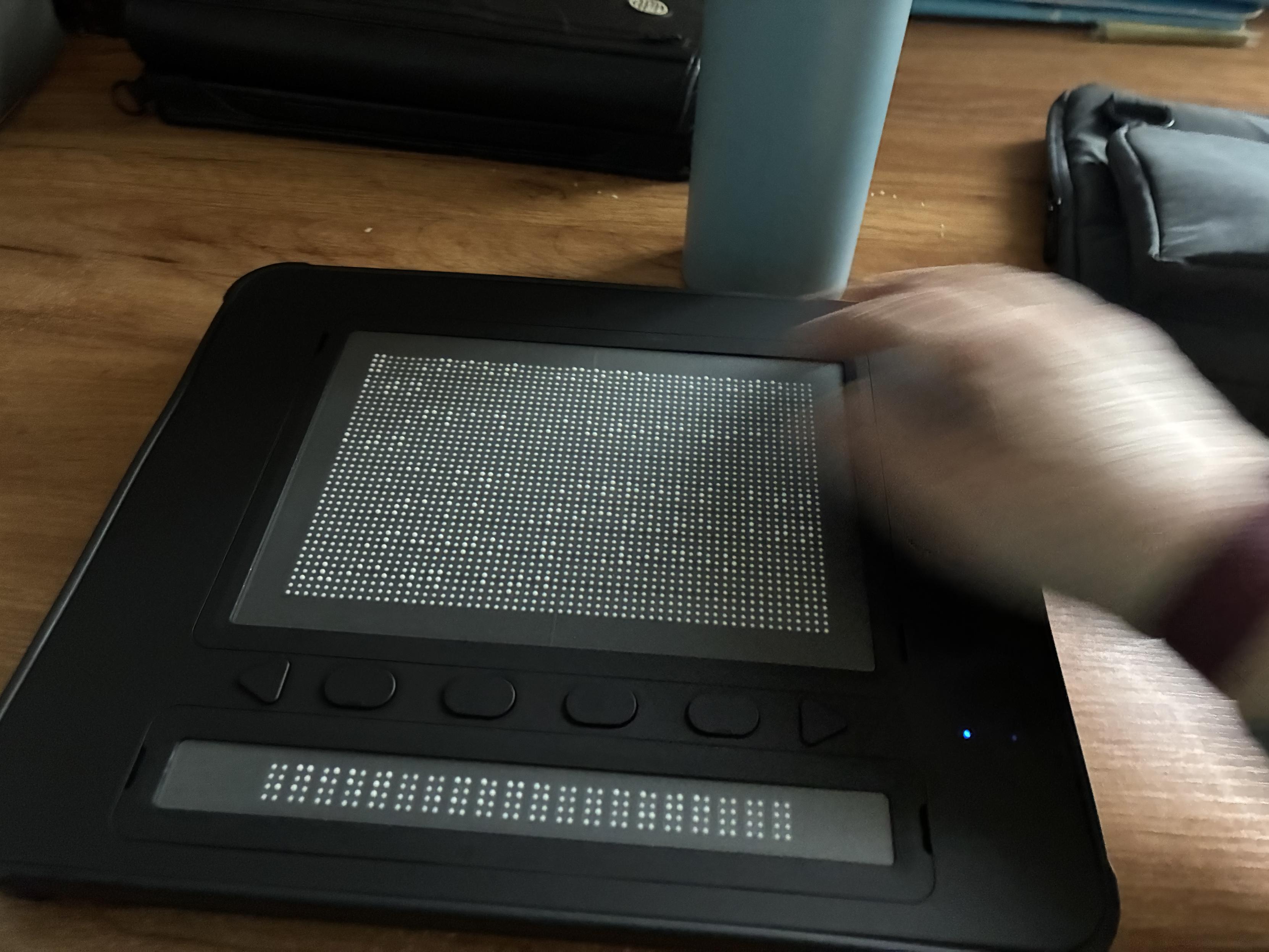
pawpower@beige.partyIt's here!!! I can't decide if I want to look at pictures or read a book! Why this is a big deal is because all of my other braille displays have one line so if you are a person who can see imagine that you only get between 20 and 40 characters before you need to scroll on one line. That is how I read all of the time. This display has a one line display at the bottom, yes, but at the top there is a larger display that is 30 x 10 that lets you read multiple lines at once or… Look at pictures! This is life-changing for me! #DeafBlind
 35
8
2
35
8
2
kasdeya
kasdeyagetting neovim to work well with Unity is a surprisingly difficult and annoying task. I might have to actually try VSCode instead
1
0
4
kasdeya
kasdeyaHouse of Necrosis Makes Your Every Move Count
this video completely sold me on House of Necrosis - I really want to play it now
but I think it also does a great job of explaining something that I love about roguelikes as a genre, too: the resource-management aspect, that’s almost like a puzzle
1
0
1
kasdeya
kasdeyaShow content
if someone is asking a good faith question online and you - personally - do not want to offer help, the correct response is not any of these:
- tell them that they’re lazy and should have searched for answers harder
- pick apart the framing of their question as a way to criticize them
- act condescending while refusing to answer
- tell them that they should never need to know the answer to their question
- derail the conversation by making it about how much smarter you are
in fact if you encounter a good faith question online and you do not want to offer help, the correct response is:
- Fuck Off. literally just Fuck Off and do anything else. navigate to any other webpage. watch a video essay. visit your local library. learn quilting. do anything else in the world other than replying to that question
2
1
11
kasdeya
kasdeya“it’s just common sense” is a way to shift the blame onto a person for not knowing, and off of their community for not telling them. if someone doesn’t know “common sense”, literally the last person to blame is the one who is ill-informed
1
1
7
kasdeya
kasdeyaI’m starting to think that a big factor in what draws people to their favorite programming languages is a subjective sense of aesthetics
there’s definitely a cultural aspect: you learn to solve problems in your native programming language and it can be hard to solve those same problems in terms of a different language paradigm, or even a somewhat different language with limitations you’re not used to
but you can overcome that cultural gap with practice if you really want to. it’s kind of a slog but it’s not the worst or anything
but what makes people push through that slog in the first place? I think it’s an aesthetic attraction to the language. people see something beautiful in the language, off in the distance, and they want to learn it in order to reach that beauty and really understand it and appreciate it
so I suspect that’s what draws people to functional programming - I think it’s an aesthetic attraction to the idea of mixing code and math, or to immutability as a concept, or to declarative programming, or etc. there’s something about it that they find beautiful and alluring. that’s what gets them through the slog of learning it, and it’s why people end up sticking with that paradigm in the long term
I think that also explains why some people’s favorite language is still Java, for example. because that was probably the first language that they really clicked with on an aesthetic level and they still get that sense of beauty from the language. even though the culture of programming languages has changed since then and younger programmers probably consider Java ugly instead of beautiful, calling a language “ugly” is completely subjective and culture-dependent
just like it is to call Haskell “elegant” or “pure” or “beautiful”. I can’t understand what that means because my cultural concept of programming beauty is different from the one that Haskell programmers have. and if I tried to explain why I find Lua or Fennel beautiful or elegant, they would probably be equally confused
1
0
6
repeated
 repeated

[17921] /bin/cat(girl) 
catgirl_so@tech.lgbt
Show content
drone network that presents a single collective serial number to those outside the hive, despite each drone being numbered for internal asset tracking purrposes. whenever a drone communicates with the outside world, its serial number is replaced with the network's collective serial number in outbound messages, and vice versa for inbound messages.
this process is known as 'network address translation'
0
3
5
kasdeya
kasdeyaShow content
I love how Arch can just be like “oh btw I’m missing this extremely basic functionality because you didn’t explicitly tell me to install the package that includes it. how were you supposed to know to install the package? the fun part is you weren’t”
“how are you supposed to figure out that this problem means you need a package, and the exact name of the package to install? idk try googling for 20-30 minutes and maybe a random website will help you”
1
0
3