

Posts
1471Following
132Followers
174"what a fascinating yet quietly terrifying being
 " @kirakira@furry.engineer
 "turbo queer" @kasdeya@cryptid.cafe
eli (ˈe̝ːli), vampire kitsune
rowan
i’m sorry / you’re welcome for flooding your timeline with old rown posts (it was trying to dig up one in particular for a conversation it was having)
 1
1
 0
0
 6
repeated
6
repeated

scrimpledly moss [Viridi Vix]
vivi@arff.archandle.netI love women and foxes and especially foxwomen
1
4
1
eli (ˈe̝ːli), vampire kitsune
rowan“im freezing, i wish there were some way i could heat my room using just my computer”
the humble electron app:
0
8
30
eli (ˈe̝ːli), vampire kitsune
rowanthings ive learned from games that also have applied to my real life
- sometimes starting over is a good idea but normally its not
- waiting for the perfect opportunity rarely pays off. picking a good enough time is often your best choice
- i prefer going through as a girl
- dont save one-time things for when you really need them. by the time you get to that point, its too late
- grinding for money fucking sucks
2
20
43

eli (ˈe̝ːli), vampire kitsune
rowanShow content
something i think a lot about is community, social and individual needs, and the conditioning against community in the united states.
mutual aid is a fascinating case study to me. online i’ve seen it pejoratively referred to as “ebegging” – even by people who do it. outside of the gross insulting version of this to discourage others from asking for help, i assume this is some type of admission of guilt or shame associated with engaging in the act and it makes me very sad we can reach a point like this, but it also makes a lot of sense to me. americans tend to be very proud of their individual achievements and aren’t very good at recognizing their involvement in groups or communities. many often suffer in silence because they feel as if their needs are too insignificant, or perhaps even that they are not in need enough to ask for help. worse yet is when someone believes they’re not worth helping.
however, when i talk to others about how would want to help others, they’re very passionate about all the ways they’d love to do it. paying off debts in creative ways, offering highly advanced and unique skills that are hard to find. they really want to show value in a way that is nuanced, personalized, and lasting. it’s very sweet and endearing but also really interesting – both to hear the contrast of accepting help versus providing it but also how grandiose it can be. i suspect many of them would not accept the help they would want to offer to others. why?
aside from the variety of personal reasons that someone could have which can’t be generalized in a nice, neat, analytically useful way, i suspect that much of it comes from wanting to be valued by others. they want to be uniquely desirable and helpful to those around them. i can’t be certain but it’s the best explanation i can come up with. one of the reasons i think this is because of our tendency to compare ourselves on the global stage. it’s not satisfying to be a big fish in a small pond but also because most of our exposure to our specialization and interests leads us to discover the most prolific identities and personalities associated with that thing. the most commercially successful artists, computer scientists, engineers, and so on; the absolutely most recognized and disproportionately advantaged individuals become our baseline for comparison. if we can’t be as good as them, how can we ever hope to be useful to our in-group?
with all of that in mind, i can’t help but feel that there’s an incredible amount of pressure to be highly proficient at something and expect nothing in return. almost like a real life hero. we become so good at something that we can solve problems for others in a way that is completely unique to our skillset. i think that’s a really cool thing and leads to a lot of amazing innovation, but i think it’s not so useful for framing mutual aid.
most people i know who desperately need mutual aid don’t need a hero. they need someone to help with the dishes, or look after their pet while they’re at work, or maybe even just be around to keep them company to feel like they’re worth it. sure, it’d be nice to meet batman or superman who could instantly pay off our mortgage or finish the home repairs in 0.5 seconds, but i think we equally need someone who is just willing to do the boring, mundane stuff too. groceries happen every week or so, cleaning happens.. well, seemingly constantly. it’s a lot. and i think that’s what community and mutual aid looks like. it’s doing what’s needed, and we need a lot of really boring regular stuff.
2
7
10
eli (ˈe̝ːli), vampire kitsune
rowanbaps your face with my many tails as you try to walk behind me
1
2
5

eli (ˈe̝ːli), vampire kitsune
rowansorry for being autistic on main about my passions, it will happen again
1
8
31
eli (ˈe̝ːli), vampire kitsune
rowan
@silvermoon82 the lifespan of a kitsune is measured in thousands of years, so rowan is probably somewhere near adolescence
1
0
1
eli (ˈe̝ːli), vampire kitsune
rowanShow content
also lmao “skill inflation”
inflates your skill making it big and round
0
1
6
eli (ˈe̝ːli), vampire kitsune
rowanShow content
in 2011, Soren Johnson wrote, “Given the opportunity, players will optimize the fun out of a game.” that idea has bothered me ever since i first heard it and i haven’t really known why. i hear it repeated in GDC talks, GMTK videos, game design podcasts, forums, and practically anywhere else where a game has any type of optimal strategy.
i’ve forever subscribed to the notion that game designers and developers aren’t the ordinants of fun. they don’t identify some objective sense of fun and build a set of rules in order to codify that fun experience. this type of mentality is most apparent in board games but can be seen anywhere. inevitably, someone will criticize a game by saying it’s not fun and — equally as inevitably — someone will reply “you weren’t playing it right.” it seems that there’s a belief that strict adherence to the designer’s vision will infallibly lead to fun and it’s the deviance which ruins the experience. i have separate, even stronger opinions about that but that’s for another time.
in my mind, game designers are more like sociologists – they try to observe what different demographics of people find fun and identify patterns. all of our information comes from observing players, not the other way around. it’s silly to think that we tell them how to have fun.
to be clear, i think the soren johnson quote has truth, particularly so when faced with issues like the skill inflation problem. in games like Overwatch, TF2, LoL, etc where as the community matures and the average skill level increases, it becomes much harder for beginners to play. the game has been so heavily optimized by the core players that outsiders can’t join (which, of course, is an eventual death sentence for the game).
but where i think the quote doesn’t make sense is when applied to single player games or games where one style of play won’t affect other players of the game. as far as i can tell, this application of the quote insinuates that players don’t know what’s most fun for themselves and, because of their overwhelming desire to win and do better, will eschew the fun modes of play for optimal ones. because of this phenomenon, we decreers of fun must protect players from themselves lest they ruin they ruin the pure vision for us, themselves, and everyone else!
who says being rewarded for playing optimally isn’t fun? obviously not everyone enjoys it, but that’s where the subjectivity of fun becomes relevant. but i’m pretty sure this is the entire appeal of puzzles – being rewarded for correctly solving it. using binding of isaac as an example, the creator lamented not adding item descriptions despite it being a deliberate design choice. he wanted to capture the sense of mystery that old games had and encourage experimentation. however in the age of the internet, it’s really hard to preserve any game mysteries so players just made wikis with all the item info. who is “at fault” for this – the players for playing incorrectly, or the creator for designing incorrectly? both? neither?
i also think it’s misguided to assume that players will play a game long-term without having fun. instead, i think that fun matures and evolves with the player. i really like melee and symphony of the night, but i most certainly don’t play them like i used to when i was young and i definitely don’t play them the way they were intended by their designers. i like to speedrun symphony of the night and i used to enjoy playing smash competitively. it’s because the games are fun that my style of play continues to change.
alright i’m realizing this should’ve been a post on my blog, it’s way too long i’m sorry. i’ll probably have more to say on this later but it’s just something that constantly bugs me.
1
3
7
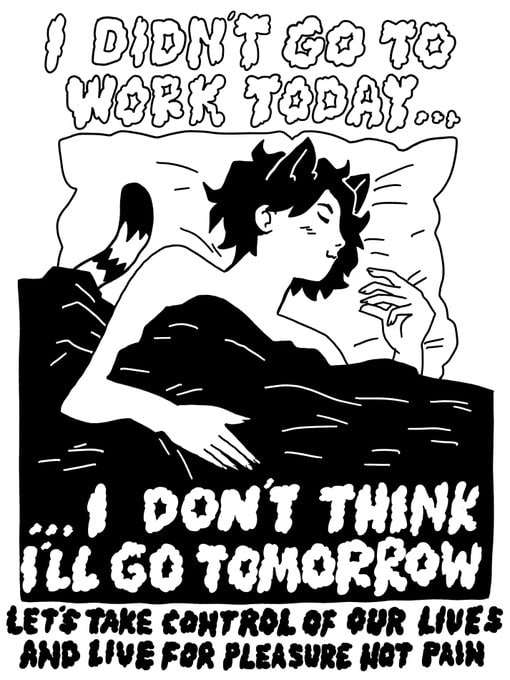
eli (ˈe̝ːli), vampire kitsune
rowanif you’re taking care of a creature, make sure to adhere to proper feeding times and its specific nutritional needs!
let’s look at a Rown’s diet as a helpful guide
- poptarts & monster
- monster
- half a box of french fries
i hope this has been useful information in caring for your very own Thing
4
5
23
repeated
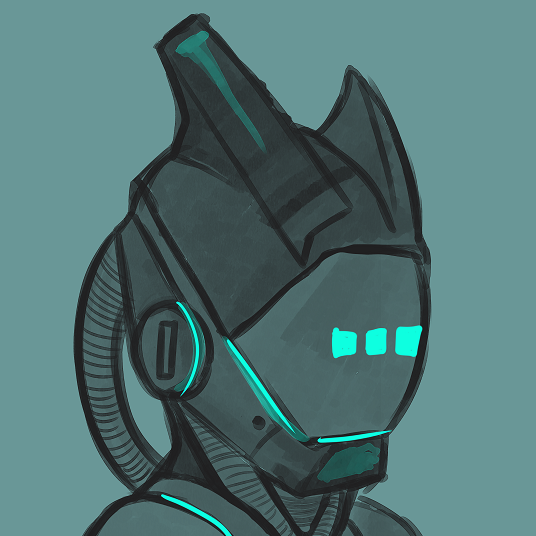
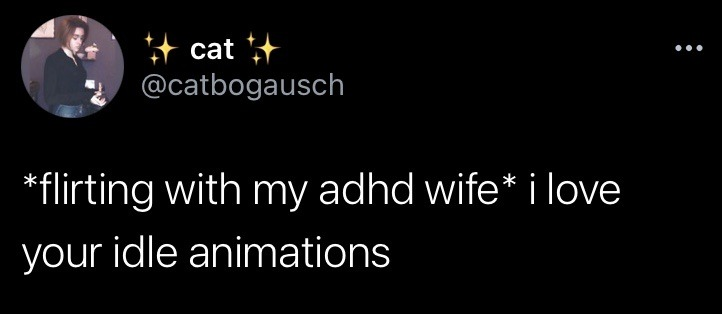
eli (ˈe̝ːli), vampire kitsune
rowan@eclairwolf since u asked my thoughts on this,
RE: https://cryptid.cafe/objects/6d8d4361-0765-4058-a4b2-9a2a82a0cd5f
0
0
3
eli (ˈe̝ːli), vampire kitsune
rowanconsider a rowan
- fox cryptid gf
- supernatural kitsune powers (will use then on you)
- loud
- bad at video games (you can always win vs her at Mario kart)
- will get overstimulated and bite you
- constantly needy and affectionate
- not smart and wants you to explain everything slowly
- will hide your things in the void for fun
- horny switch
- cooks for you (you Will enjoy spicy food)
- bad jokes that only it understands
- emotionally dysregulated
- looking at it for too long means it will claim you for its own
3
3
20
eli (ˈe̝ːli), vampire kitsune
rowan“That gives me pause” - negative connotation, boring, weak, implies hesitation
“That gives me paws” - positive connotation, wish fulfillment, baps you
1
24
66