

Posts
3011Following
122Followers
695I try to be very careful about CWing things. sometimes I make mistakes but I want to make my posts as safe to read as possible
I sometimes post NSFW/kinky/lewd things behind CWs. this should go without saying but if you're a minor please do not interact with anything lewd/NSFW that I post
I have very limited energy and am very shy so it might take me a long time to reply to messages sometimes, or I might not be able to reply at all. this is kind of an "output only" account for the most part, but I'm hopeful that I can change that over time
I sometimes use curly braces to {clearly show where a grammatical phrase begins and ends}, like that. you can think of them like parenthesis in code or math, except they operate on grammar instead
kasdeya
kasdeya
come to think of it, you could fix the noisiness by having two sets of syntax: the usual long-form { } syntax and a short-form [ ] syntax for when you want to make a simple, quick literal:
let someNums = [1, 2, 3, 4]
let aDict = [
    "foo" = "bar",
    "baz" = "qux",
    1337 = 7331,
]
both would create the same type of value (a Lua-style table) but one would be a shortened form of the other
 0
0
 0
0
 2
2
kasdeya
kasdeyaimagine a language like Lua except every table literal is actually a block of code that is run like a module. for example:
let someTable = {
    export someValue = "foo"
    let privateValue = "bar"
}

print(someTable.someValue)
# prints "foo"

print(someTable.privateValue)
# error
that would mean that when you require("someModule") you’re essentially wrapping the entire someModule file inside of { } and getting the result
it would make table literals more noisy but it would also let a Lua-like language have even fewer concepts that need to be learned in order to understand it
plus, you could define a whole class inside of one set of { } which would make the syntax mirror how most other languages do classes - and create a visual divide between the class and any unrelated stuff that might exist in the same file:
let SomeClass = {
    export new = (value) -> {
        let newInstance = {
            let privateValue = value
        }

        setmetatable(newInstance, this)
        return newInstance
    }

    export getValue = (this) -> {
        return this.privateValue
    }

    export setValue = (this, value) -> {
        this.privateValue = value
    }
}

let instance = SomeClass.new("foo")
you could even make it so that if you return inside of { } then the whole { } block evaluates to whatever you returned, so you can have multiple statements inside of your expressions (and not just table expressions) just like in Lisp:
let fibonacciNums = {
    let a, b = 0, 1
    let nums = {}

    for _ in range(100) do
        a, b = b, a+b
        list.push(nums, a)
    end

    return nums
}

print(fibonacciNums)
# {1, 1, 2, 3, 5, ...}
kasdeya
kasdeya@harmonycorrupted @trinityblair I’m curious why not - do they have bad associations with the platform, or just see it as too niche?
2
0
5
repeated

 repeated

Chris Trottier
atomicpoet@atomicpoet.org
It says they carefully retrieved my product from their inventory with sterilized anti-bacterial gloves and placed it on a satin silk cushion.
The party they organized to celebrate my order lasted 3 days. When the time came, the clamoring crowd cheered through the city as the procession made its way to the post office.
A team of 50 experts proceeded to inspect the product. They polished it until it shine and bid it farewell with a tender caress.
The postal service then took over, using one of their many private jets to send your product as fast as possible. Give. It's inestimable value, two fighter jets were dispatched to ensure it's safe arrival.
Their internationally renowned packaging specialist (who came straight from Korea (lit candles and incense sticks. Absolute silence set as he placed the product in its box.
They've placed my photo in a 50x50 food frame and selected me as customer of the century. (Unfortunately this position may be contested in the year 2100).
They then offered to send me another version of this comic with a real photo of me (or my pet) on it that's printable.
 1
2
1
repeated
1
2
1
repeated

Violinknitter
Violinknitter@wandering.shopRandom violin teaching moment
One my favorite questions to ask is: “What did we do in here together that you wouldn’t have thought to do on your own?”
A primary goal for me as a teacher is to teach students how to teach themselves. I want them to be as independent as possible and have the tools to learn and play music on their own
1
2
1
repeated

 (aka kemona_halftau)

kasdeya
kasdeyaShow content
the problem with Windows is that it can take a lot of tinkering to get Linux software to run
the problem with Linux is that it can take a lot of tinkering to get Linux software to run
2
5
17
repeated



 repeated
Fedi.Tips
FediTips@social.growyourown.servicesIt is depressing if someone experiences hate on here, especially if it puts them off using this place.
I follow people that regularly raise these issues, to hear how bad it is and what the causes are.
Five things seem to come up most often:
- Lack of representation in software design
- Users not being able to control who can reply to their posts
- Moderation being reactive rather than proactive
- Allowlists vs blocklists
- Cultural problems
Let's look closer...
🧵 Thread - Part 1 of 7
1
3
1
repeated

emmatyping 🏳️⚧️
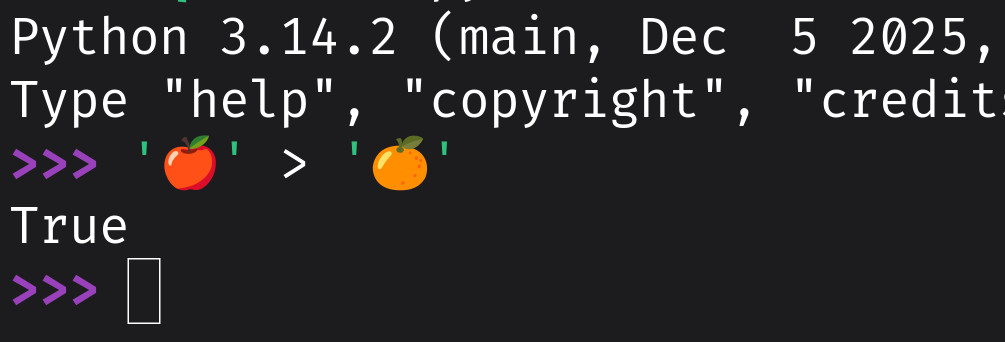
emmatyping@hachyderm.ioPeople say you shouldn't compare apples and oranges but it seems to work fine for me in Python 3.14, I don't see what the issue is...
 2
8
4
repeated
2
8
4
repeated

Made me smile 🫧
MadeMeSmile@mastodon.socialThe Japanese Bee Fly mimics a bee, is super cute and was the inspiration for the Pokemon Cutiefly
 4
2
1
repeated
4
2
1
repeated

🅰🅻🅸🅲🅴 (🌈🦄)
alice@lgbtqia.spaceHey Fedi,
How are you doing today?
Everything okay? Do you need a hug?
I bet you could use a hug.
🫂
60
3
2
kasdeya
kasdeyaa thing about Lisps that I find very beautiful is that you can learn their basic rules (syntax, macros, and execution) very quickly and easily*, and after that point you’ll understand all you need in order to make sense of anyone else’s code (as long as you can look up the forms that they’re using). you’ll never run into a situation where you don’t know what you’re looking at, syntactically speaking - which can happen a lot in non-Lisp languages
but a big complaint that I have about Racket is:
- compared to other Lisps, it has a lot of special-case syntax
- there’s no single place in the Racket Guide (the friendly, readable reference guide for Racket) that explains all of the syntax. instead, the syntax is spread throughout the guide
- there is a single place in the Racket Reference that explains all of the special-case syntax, but the Racket Reference is an extremely dense and challenging read (I’m not entirely sure why they decided to write it this way. it reads more like a formal standard for the language than a reference guide. everything is explained in excruciatingly precise detail and there is a lot of Racket-specific jargon being thrown around as well)
I get the feeling that Racket is overall a very complex and densely-packed language - designed to give users as many options as possible. and I have mixed feelings about that approach. it makes the language less beautiful to me, and harder to learn, but there might be a lot of practical value in doing things that way
* nothing involving programming is quick and easy, but it’s “very quick and easy” compared to learning the equivalent information in almost any other language
0
0
3
kasdeya
kasdeyafirst impressions of #Racket seem pretty good! it has some stuff that I don’t like from other Lisps like:
- a weird pseudo-module system instead of a proper module system
- an unnecessarily large number of ways to compare values
- several forms that implicitly add new functions to the namespace
it’s also a very very complex language compared to Janet or Fennel. but the things that I really like about it are:
- the Racket folks clearly care deeply about people’s first time experience with the language and have made it incredibly smooth and easy in many different ways (they even have a nice, friendly little IDE called DrRacket that comes with every Racket installation)
- it has easy, out-of-the-box Windows support! (this is pretty rare with Lisps)
- the documentation is fantastic. it’s not just incredibly thorough and well-explained, it’s also split into {documentation for beginners} and {full and complete documentation for masochists} sections, and everything is heavily linked together with hyperlinks to more documentation that explains things even further
my overall first impression of Racket is that it’s the Python of Lisps: it’s very complex and full-featured, but it also cares deeply about being as easy and friendly for beginners as possible, and I think that’s one of the most important traits for a language to have
1
2
8
repeated

On the next episode of Sweaty Bearded Men Cussing a Lot While Doing Manly Jobs (only on the Discovery Channel): another mechanical failure threatens the livelihoods of the sweaty men! Can they overcome this equipment failure throw sheer force of swear words and turn a profit?
1
2
1
kasdeya
kasdeyaShow content
@tempest I really am too. until I found Fedi I thought that the entire internet was like that, and I even thought that it was normal. but I’m glad that I have some perspective now and I’m not steeped in that toxic culture anymore
1
0
1
repeated

kasdeya
kasdeyaShow content
code is a pidgin language between computers and people. computers are very logical and consistent, but people are incredibly messy and chaotic and diverse
there’s such a wide variety of programming languages and styles (imperative, object-oriented, statically-typed, functional, etc.) because those styles are meant to serve different cultures of problem-solving, which value different things (speed, various definitions of “elegance”, various definitions of “safety”, etc.)
I grew up on reddit, though, where every user has to find a reason why they’re smarter and better than all of the other users. so I grew up hearing sentiments like:
- “functional programming is objectively superior. it’s so easy to understand and use and if it’s ever hard for you that means you’re stupid and don’t understand its deep elegance and precision mathematical design. [derails the conversation to show off their knowledge of Monads™]”
- “Rust is literally the best possible language because it’s just as easy as Python except everything is so safe and fast and if you ever have trouble with it that just means you’re stupid and shouldn’t write code. Rust is always completely effortless to write and read because of how superior it is”
and I learned to be very defensive about what works for me, because the cultural assumption was that one of these languages must be the superior choice and only a chosen few geniuses can understand which it is and use it properly - and I didn’t want to be one of those ignorant plebs using an inferior language for idiots instead. so that’s why I am the way I am towards Rust and anything related to functional programming
1
0
5