

Posts
2785Following
119Followers
684I try to be very careful about CWing things. sometimes I make mistakes but I want to make my posts as safe to read as possible
I sometimes post NSFW/kinky/lewd things behind CWs. this should go without saying but if you're a minor please do not interact with anything lewd/NSFW that I post
I have very limited energy and am very shy so it might take me a long time to reply to messages sometimes, or I might not be able to reply at all. this is kind of an "output only" account for the most part, but I'm hopeful that I can change that over time
I sometimes use curly braces to {clearly show where a grammatical phrase begins and ends}, like that. you can think of them like parenthesis in code or math, except they operate on grammar instead
kasdeya
kasdeya
in the past I used to be so worried about all of Wikipedia’s complicated rules about grammar and sounding formal and etc. to the point that it scared me away from editing at all
but now I just don’t care. someone else can edit my writing to sound “formal” and “professional” if they want but what matters is that I’m taking text that was impenetrable to laypeople like me and making it (I hope) dramatically easier to read
 0
0
 0
0
 5
5
kasdeya
kasdeyanow that I’ve gotten slightly more comfortable editing Wikipedia, I’ve found a fun way to hopefully make small bits of Wikipedia pages easier to read and understand
whenever I’m on a Wikipedia rabbit hole and I’m having trouble understanding what a section is trying to say, (usually because it’s very terse and using a lot of jargon) I’ll try to figure it out by reading other articles or other stuff on the internet, and edit the article as I understand more. it’s like I’m taking notes as I read, but it also (hopefully) helps others too
I don’t have a lot of attention span though so I usually only edit like 1-2 paragraphs per page, but still. I’m pretty proud of how much I cleaned up some of the text that I’ve edited idk
1
0
3
kasdeya
kasdeya
@Shivaekul omg yeah one thing that Lua is terrible at is giving you feedback on anything that you’re doing. I had to do so much trial-and-error with TellMeWhen in order to get my very very basic Lua to work - but none of that would’ve been necessary if I just had a decent REPL to explore WoW’s Lua environment
but I hope that you can figure it out eventually, if you want to!
0
0
1
kasdeya
kasdeya“kas you literally just said not to criticize art”
with some exceptions, TV shows and movies are not art - they’re content. content is the result of a corporate assembly line. art is something that was created with love and passion for no reason other than to bring it into the world. when I say not to criticize art, I’m talking about the art of random people online, not the “art” of a massive media conglomerate
1
0
2
kasdeya
kasdeyaShow content
I could keep ranting about this but what I especially want to say is: how dare they do this to Star Trek in particular. how dare they take one of the most utopian and progressive and mature and idealistic shows in popular culture and turn it into cynicism slop. when the world needs idealism and hope more than ever, how dare they
1
0
1
kasdeya
kasdeyawe’re at a point now where these defense mechanisms against internet assholery have even leaked into TV and movies. there are so many TV shows, for example, that are terrified of unironic sincerity or positivity or optimism in any form. any time a character expresses any affirmative value whatsoever it’s usually the show going “lol look at this fuckin loser having morals and ideals”, or at the very least it’s presented ambiguously enough that the writers can claim that that was the intent
the result is a whole bunch of storytelling that has nothing to express other than criticism, contempt, cynicism, and ridicule
1
0
5
kasdeya
kasdeyaShow content
before criticizing someone else’s art, consider these questions:
- did they ask for constructive criticism?
- you are trying to be constructive with your criticism, right?
- have you carefully worded your feedback so that it is gentle and constructive and sounds more like helpful feedback than criticism?
if you answered “no” to one or more of these questions and you still feel the need to post your criticism, please try your absolute hardest to make a piece of art and then post it publicly on twitter dot com so that you can learn some fucking empathy
1
0
3
kasdeya
kasdeya“I had a dream that…” is internet-speak for “y’all fuckers will clown on me if I show the vulnerability of admitting that this came from my daytime creativity”
and you know what? I’m glad that there are workarounds for showing vulnerability and creativity online without the risk of getting absolutely blasted for it
but I do wish that internet culture as a whole could just, grow up enough that people don’t have to frame everything as coming from their subconscious or whatever
what a utopia we would live in if artists felt safe to share their vulnerable selves completely online, without any trace of irony or self-deprecation or any other defense mechanism at all. imagine how much more art we would have, and how much more varied and beautiful it would be
1
0
3
kasdeya
kasdeya@Shivaekul hehe - I’m using WinCompose which is one of my favorite pieces of Windows software ever. it emulates the functionality of the compose key on Linux, so I can press a configurable key (for me it’s the menu key) followed by a sequence of other keys in order to type special characters
for example I can type a lowercase lambda with [compose]*l (the compose key, then asterisk, the lowercase l) and uppercase lambda is the same except capital L. all of the Greek letters are like that - for example π and Π are *p and *P
a lot of the key sequences are really intuitive, too, like u + " = ü, and you can configure your own sequences - like for me bh is a [b]lue [h]eart: 💙
anyway enough evangelizing it lol. but I do love it a lot
and yeah that’s totally fair! I love that Lua is designed to be {the minimum number of concepts needed in order to be a somewhat comfortable scripting language}. it constantly recycles concepts in new contexts and clever ways so that it’s extremely easy to conceptualize the entire language, and there’s very very little magic… but it’s also Very Painful to work with on Windows unless it’s embedded in something else. and even then it often asks you to reinvent an entire usable standard library from scratch lol. though it’s much much better on Linux, which is why I’m playing with it through WSL
1
0
1
repeated

 repeated

malecoded_dyke@weirder.queer.bond
malecoded_dyke@weirder.queer.bondShow content
I am Once Again posting about how digital sex should count as a form of sex & how including it in the category of types of sex = more opportunities to teach folks good DIGITAL sex ed. Bc the net is severely lacking in resources on how to keep urself safe during non-physical text, video, or audio sex. We got the basic netiquette & "block boundary breakers" but not...much else.... nobody's teaching anyone that all the IRL rules that can apply to digital situations do apply to erp. I DO think digital aftercare is necessary. I think taking it seriously & respecting it as a form of sex isn't silly & should never be considered silly. Furthermore, there are asexualities that favor exclusively digital sexual activity & zero irl contact, & we shouldn't be making anyone with them feel like their preferences & sexuality is lesser than.
0
8
3
repeated

Foone🏳️⚧️
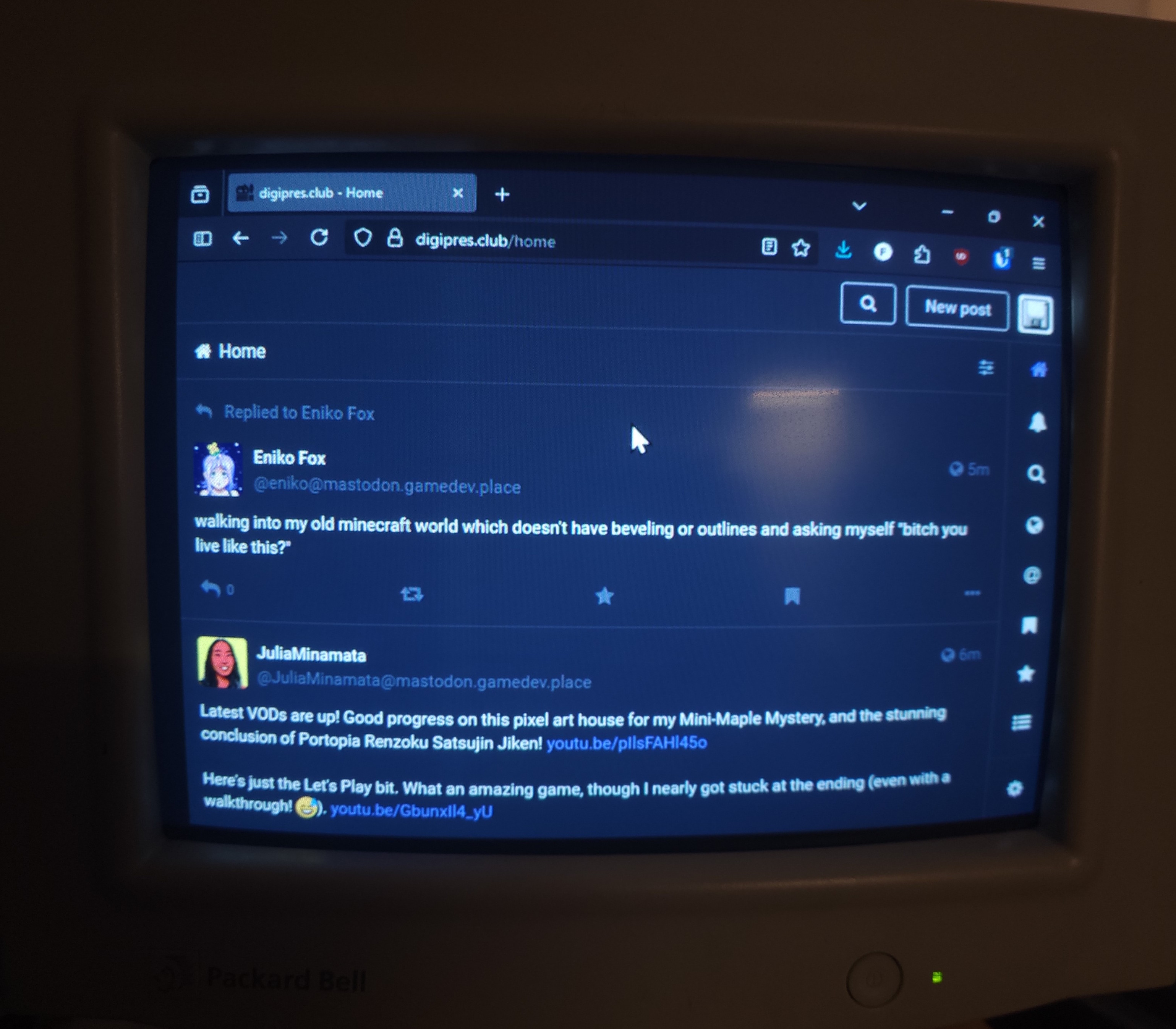
foone@digipres.clubhah. looking at mastodon on a CRT, and it triggered the "your screen is so small, it must be a phone!" styling
 5
4
2
repeated
5
4
2
repeated

 repeated

kasdeya
kasdeya@Shivaekul hehehe - yeah Fennel will also let you type lambda but I thought it was so cool that it let me use λ that I’ve been doing that instead
and also yeah! it helps a lot for me to be able to immediately see where assignment is happening like that. the parenthesis still trip me up a lot but the square brackets definitely help
and thank you! yeah this is the perfect introduction to Lisps for me because everything is extremely simple and I already know how Lua works, and this is basically just a thin layer on top of Lua
1
0
1
kasdeya
kasdeyaapparently people are working on tooling to add Fennel to the Neovim ecosystem so you can write your Neovim config in a Lisp-like language. that has me hopeful that fennel-ls (a Fennel LSP that Needs Some Work) will continue to improve
0
0
2
kasdeya
kasdeyaanyway here’s my Fennel sandbox repo if anyone is curious what Fennel looks like. it’s probably too Lua-like to appeal to Lisp users and too Lisp-like to appeal to anyone else
but idk I think I kinda like it. it’s aggressively counterintuitive yet very simple
2
0
3
kasdeya
kasdeyaokay it’s actually surprising me a lot how quickly I’m getting used to Fennel’s Lisp-like syntax. it’s really not that difficult for me to work with at all anymore, though it’s definitely still unfamiliar enough that it takes me a second to translate what I want to do into Parenthesis Speak
also the lack of type-checking is causing a lot of problems. or really, it’s just making problems much harder to track down and only apparent at runtime. clearly the best solution to this problem is to create a typed version of Fennel that transpiles into Fennel, which can then transpile into Lua
(please don’t actually do that)
1
0
4
repeated

Cassandra is only carbon now
xgranade@wandering.shopThesis: GOTO is bad for managing complex code.
Antithesis: GOTO put humans on the moon.
Synthesis: going to the moon required less software complexity than modern frameworks require of "apps."
1
2
1