
Winter 
winter@translunar.academy

most people (or I am doing the xkcd comic thing again) probably have some idea that gravity wells have weird effects on the local passage of time and that time dilation occurs near very massive objects like black holes
this property of spacetime called relativity has tangible effects even over much smaller scales such as the gravitational difference between Earth and the Moon. on the Moon, an atomic clock will complete 24 standard hours 53 microseconds faster than the same device on Earth. this amounts to a gain of one second for the Moon every fifty Earth years or so
as recently as 2024 humans have come to realize this could actually cause problems as many different countries and corporations explore the Moon each under their own command in the coming decades — a one second discrepancy in a joint space mission could potentially cause Serious problems. so there has since been an international effort to decide a universal Coordinated Lunar Time system. the math to solve this problem is anything but simple
behold one of the first major efforts toward LTC, developed by Chinese researchers and released for free to the world: https://github.com/xlucn/LTE440
this software brings the accuracy up from a discrepancy of one second per fifty years to just 15 nanoseconds, good enough to be stable for thousands of years. unless the US or European proposals underway prove more accurate, it may be the best system we have until someone actually lands an array of atomic clocks on the Moon similar to how precise time is kept on Earth
 1
1
 3
3
 1
1

kasdeya
kasdeyamost people (or I am doing the xkcd comic thing again) probably have some idea that gravity wells have weird effects on the local passage of time
omg wait do gravity wells affect the passage of time indirectly, because they like to move objects at high velocities? or is it possible to be completely stationary next to a completely stationary gravity well and still have the passage of time be affected?
4
0
3
Winter
winter@translunar.academy
1
0
2

Leinna
leinna@fedi.kemonomimi.pet
1
0
3
Leinna
leinna@fedi.kemonomimi.petThat is the equivalence principle, which says that you cannot distinguish between being accelerated at 1g, or being affected by a gravitational field at 1g. Like say you are in space, and your spaceship accelerates at 1g, you would be pushed in the opposite direction of where you were moving right? This is indistinguishable from gravity!!
So following that, if we cant distinguish between gravity and acceleration, the same effects that change time should apply to both. Which means that even if you are still, since you experience the acceleration from the planet your time will change exactly as if you were moving on a spaceship accelerating at the rate of gravity.
And this would allow you to time travel by both methods, either you accelerate really fast, or you go near a massive body. However you can only travel into the future, so you have to be careful about that :3
Sry for long text I find this really cool
1
2
2
kasdeya
kasdeya@leinna @winter woahh that is fucking wild but I think it at least kinda makes sense?
like if you’re freefalling, it feels like you’re weightless because presumably you’re accelerating downwards in a way that perfectly counteracts the upwards acceleration of gravity
so is it acceleration that causes time dilation, and not speed? I thought it was speed but I might be wrong
this was a really interesting read btw! and thanks for explaining this
2
0
0

Ludovic Archivist Lagouardette
Archivist@social.linux.pizza@kasdeya @winter when you are in a gravity well , space itself is moving "downwards" which is why we fall so even stationary inside a gravity well , you are moving. It is the elevator rule: you can't differentiate being in a constantly accelerating elevator in space or in a stationary elevator in a gravity well, so the acceleration affects the universe the same in both cases
0
0
2
 0
0
2
0
0
3
0
0
2
0
0
3
Leinna
leinna@fedi.kemonomimi.petShow content
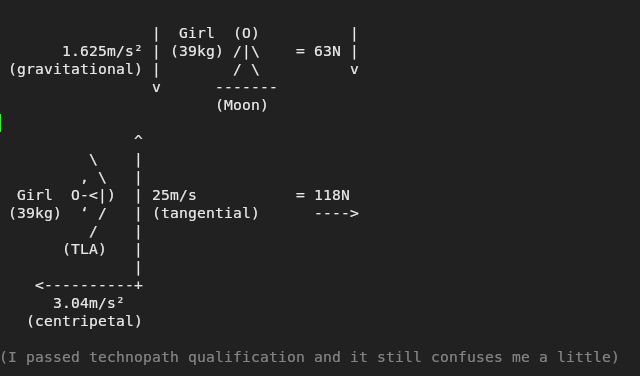
Well in the first example. we have two forces that cancel each other out perfectly, The force of gravity and the force normal force that ground of the moon is applying onto you. There isnt any big mystery here, except that in the end the forces cancel out and you are left with net 0 force. You can imagine it as when you are holding something in your hand. That object is pushing down on your hand, and you have to apply an upwards force to keep it in place. If you dont push up, it falls. The arrow you drew on the side is only the gravitational force, but if you want to know what it represents, it would represent the weight (not mass) that the girl weights on the moon. You are missing the arrow that represents the upwards force of the ground, also 63N, so that the total force is 0 (she is standing still :3)
The second example looks just like an orbiting body, so in this case there actually is only one single force acting on the body, being the gravitational one. You wrote centripetal, but the centripetal force isnt a "real" force, it is a name for a force that represents a pull onto the center (circular orbits only). So the real force applied is the gravitational one, and you can write the gravitational force as a centripetal force, but the only force is gravity. So you have your body that is pulled inwards by gravitational force, and thats it! If you had no velocity, you would just start free-falling.
But since you do have velocity, you enter orbit. Why do you start orbiting? Because by moving to the side, you are "dodging" the planet. You are basically in free fall, but your sideways velocity is causing you to move away faster from the ground than you are falling towards it. I got an intuitive idea for it imagining myself throwing a ball at increasing speed on a small planet. If I just drop it it falls, if I throw it faster, it will land farther away, and have been in freefall longer. If I throw it *really* fast, its moving so far sideways that it just never touches the ground! So thats what causes and orbit, only a single force. And you feel weightless because you are in what is essentially a constant freefall! On your diagram you have an arrow that points outwards, which I assume you think would be the centrifugal force? That force does not show up when something is orbiting, it can only be applied to a rotating frame of reference, which an orbit is not. So the arrow that you drew should point the opposite way, to the center of mass of the central body.
So to wrap up there should only be a single force arrow, the force of gravity, and you can draw a second velocity arrow too for the sideways velocity of the girl.
No idea if you wanted an explanation or if you wanted to run the numbers, but as an exercise for the reader you can try to calculate the radius of the orbit and mass of the planet from the second example, assuming circular orbit. Youll have to use both the formula for centripetal and gravitational force >.<
Sry if this is not what you wanted answered or too wordy or whatever I just woke up and am kinda tired @-@
Here are my sources for the images:
https://www.qrg.northwestern.edu/projects/vss/docs/space-environment/1-what-causes-an-orbit.html
https://mechanicalengineering.softecksblog.in/882/


 1
0
0
1
0
0
Leinna
leinna@fedi.kemonomimi.petOk so do you want the effects of relativity on a rotating cylinder in orbit? I assume so since the thread was about that. I tried to keep it simple, there are a lot of concept I havent mentioned that you would have to take into account if you wanted to get an accurate number, but more or less the main time dilation effects that apply are somewhat simple
First of, my explanation about how gravity is acceleration and they cause the same effect was a bit (quite a lot) simplified. Because while they are identical from a local point, they are not from a global one and do not affect time the same way. You locally can not tell if its gravity or acceleration cause the local time-dilation effects are the same. In the rotating cylinder example time dilation is caused by the relative velocity of the girl to a point of reference. In general relativity time dilation is only caused by the curvature of space-time. Artificial gravity does not bend space-time and thus the time-dilation caused by the cylinder is only a consequence of special relativity (which emulates the effect by general relativity, and was the bridge that Einstein used to go from one to the other).
So we can ignore general relativity for now and only focus on special relativity and the effect of the velocity of the cylinder orbiting the planet, and the rotation of the cylinder. In essence, inside the cylinder the girls clock passes slower than on earth, since she is moving relative to earth. If you want numbers you have to integrate over the velocity to get the final average Lorentz factor (or something similar)
Now general relativity does have some effect, but its not caused by the cylinder but by being near a planet. Like GPS satellites, depending on how far you are from earth your time passes faster due to less gravitational potential (less bending of space-time). And then inside the cylinder the equivalence principle applies, which means that you, inside the cylinder, can not distinguish it from normal gravity locally (you actually can inside a rotating reference frame cause of the Coriolis effect). That means in terms of relativity if you have a clock on the floor and one on a 2 meter shelf, the one higher up will experience time faster.
So in conclusion, you have the time dilation caused by general reality just by being inside the earths gravitational field, and then you have to add the effect of special relativity of moving relative to an observer on earth. Inside the cylinder you experience similar effects to an actual gravitational field, but its is a consequence of velocity, not of bending of spacetime.
If this is not what you mean you do have to explain yourself more clearly lol. I have spend quite a lot of time on this to ensure it is accurate and simple, so I hope it helps :3
1
0
1
Leinna
leinna@fedi.kemonomimi.pet@winter @kasdeya Sure if you have any more questions just ask, but I prob wont respond quickly nor go into as much detail cause I need to do other things. And all my knowledge is just stuff Ive read over the years so I may not be able to answer anything more than that anyway… But if you want to go into more detail id recommend you to read and understand the twin paradox, since it covers basically all aspects of special relativity. Its pretty interesting and the explanation includes stuff like:
In a sense, during the U-turn the plane of simultaneity jumps from blue to red and very quickly sweeps over a large segment of the world line of the Earth-based twin.
https://en.wikipedia.org/wiki/Twin_paradox
https://math.ucr.edu/home/baez/physics/Relativity/SR/clock.html
0
0
0